

Years ago, I was the Manager of Assets & Balances at Coinbase. I learned a lot about tokenization when USDC briefly de-pegged to $0.88. Here, I’ll apply those lessons about tokenized dollars to current events around Tokenized Stocks.
Why Tokenize a Stock?
Every marketplace wants to make transactions more efficient (think “cheaper” “faster” “easier”). For many online exchanges, these 3 metrics are maxed out, so it’s hard to offer a differentiated product that grows revenue at a sustained rate, especially with competitive downward pressure on trading fees. That’s why “simple” exchanges like Robinhood and Coinbase keep launching whacky new products like stocks, crypto, derivatives, sports gambling prediction markets, debit cards, high-yield cash-equivalent accounts, agentic-trading connectors, and a growing suite of fintech offerings. They need new markets for their existing users, or new users for their existing markets.
Tokenized stocks provide the latter. As an international poor person retail investor, it’s hard to directly participate in the US equities market. Supposedly, for many of these people, funding a crypto wallet to interact with a decentralized, blockchain-powered exchange for synthetic stocks is easier than onboarding to a traditional brokerage. This is the explicit thesis, as stated by the CEO of Coinbase. Personally, I think the implicit thesis has more to do with AI agents preferring blockchain transactions, but this doesn’t play as well with the regulators… they need some indication that this is good for Americans.
So, because they lack a single strong argument on why US investors need this, Coinbase and Robinhood have made a lot of weak arguments. 24/7 trading has been available to retail investors, without a blockchain, for a while now. But today, SEC Commissioner Mark Uyeda released an Innovation Exemption for tokenized stocks, citing:
the potential to modernize core market infrastructure functions, such as issuance, trading, transfer, settlement, and recording ownership, with the potential to reduce costs, enhance transparency, and expand liquidity.
In my brief assessment, nobody in the United States should care about tokenized stocks. The only impact most Americans should see is a small bump in demand as it becomes easier for very small international buyers to bid up the price of US equities, and even this will be slow and insignificant. It’s unlikely that anyone will develop better financial products by combining these tokenized stocks with novel smart contracts to create synthetic shorts or longs or perps or some derivative monstrosity with a bonding curve. I don’t think anything will happen, and that’s why I was surprised to see Adam Aron, the CEO of AMC theaters, absolutely livid about Robinhood’s launch of this incremental fintech product:
“I find this practice to be contemptible, outrageous, disgusting, detestable, inexcusable, vile. How can it possibly be legal?”
Looking into this, I found 3 interesting angles to consider:
AMC’s stock price is down 99% (unrelated to blockchain, but strongly related to Robinhood).
Tokenized stocks have weak-points, but shareholder privilege transfer isn’t one of them.
The future of agentic trading.
$AMC is down 99%
In my opinion, Adam’s feedback has more to do with attention-seeking than it does with any actual concern about the legality of tokenized stocks. He wants attention because AMC stock is currently down 99% from its all-time-high 5 years ago, back when it was a meme-stock thanks to Reddit and Robinhood (similar to GameStop). So, starting any conversation with the Robinhood audience is a reasonable last-ditch effort. I actually think he is considering the hail-mary chance that the same Redditors turn the former meme-stock into a meme-coin. I mean, it’s not going to work… but I don’t have any better ideas to pump the price of AMC stock.
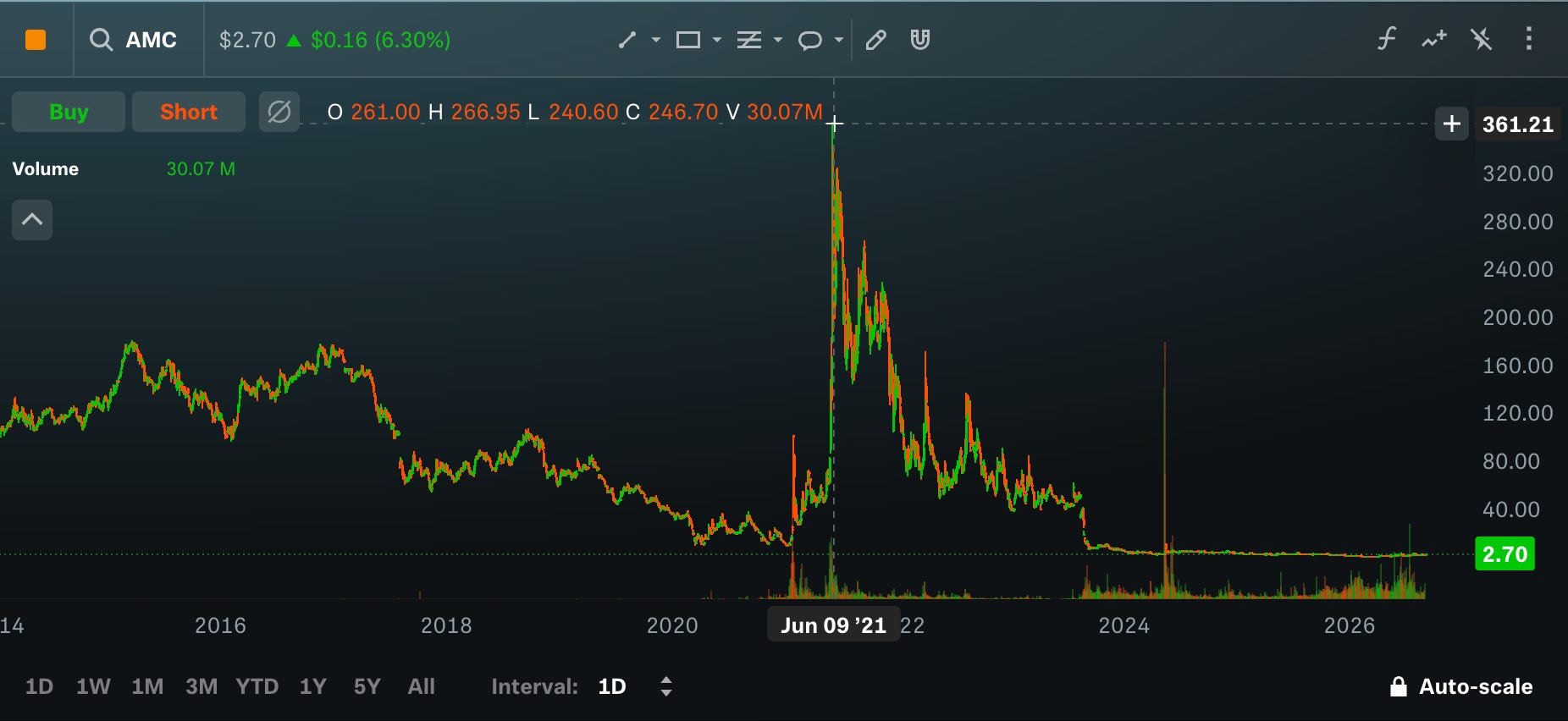
The other cynical angle is that AMC is a failing company that recently dumped billions of dollars of inflated stock on retail traders. Adam is likely to be out of a job soon (as CEOs of failing companies often are) and is looking to reposition himself on the way out, both to blame-shift AMC’s performance to Robinhood and also to align his personal brand as somehow fighting for the rights of those retail traders… good luck!
Whatever his motivations are, let’s take a look at these tokenized stocks he’s ranting about.
Flaws of Tokenized Stocks
Shareholder Voting Privileges
To understand how these tokenized stocks work, let’s first examine normal stock ownership. For large stakeholders, features like shareholder rights and voting privileges actually matter. Most people never think about this because it would be a waste of time to vote with 0.000001% of the shares.
HOWEVER, if a single platform collectively holds the shares on behalf of its retail users, without explicitly transferring all the voting rights to those users, it could do the maximally-evil thing and vote all of those shares itself, as the platform. That’s obviously not going to happen, but this interview does not inspire confidence (seriously, who is letting this guy pick his outfits and speak in interviews?):
In short, even though we have no legal precedent for which shareholder privileges transfer to the custodial institution vs the synthetic asset holder, the obvious competitive market forces will cause the platforms to provide the best customer experience in this regard. I’m sure there will be challenges because they don’t necessarily have the info on the identity of the shareholders, which creates small issues… but until an anonymous crypto trader buys 51% of AMC on a decentralized exchange, this really won’t matter (that would be hilarious, though).
Price-pegging
This is what I would actually worry about, but I wouldn’t lose sleep over the idea. It’s already common for the price of certain stocks to differ slightly across multiple exchanges, so there will certainly be some drift between the price of the token and the price of the stock. Historically, the “solution” is that massive hedge funds will build high-frequency trading operations to find and exploit these tiny arbitrage opportunities. In one sense, these tokenized securities venues (TSVs, like Robinhood and Coinbase) are simply another exchange / brokerage / order-book / whatever you call the players in this space.
But still, if there is any potential for disaster, it’s in this price-pegging. I’m not sure exactly how it will happen, but if it’s anything like the stablecoin failure at Coinbase, it will come from somewhere unexpected.
A long time ago, in 2022, I was the Manager of Assets and Balances at Coinbase. To make a long story short, we got really excited about stablecoins. The business model was to custody dollars and issue tokens. While people blasted those tokens around their favorite blockchains, Coinbase would invest some of the dollars in short-dated US treasuries to earn yield (and, to be fair, share most of it back to the user). Everyone was worried about some obvious failure modes, and we put a lot of work into preparing for them:
Lack of 1-1 backing: Many other stablecoins (Terra Luna) literally failed because they were backed by something more complicated than a dollar or a UST bond. Other stablecoins (Tether) caused a loss of confidence in the industry because they were
obviouslyallegedly, at some point, issuing more coins than they had dollars backing.Coinbase partnered with Circle to promote the USDC stablecoin, and the 2 regulated US companies provided a lot of transparency here through efforts like a new foundation (Center) and lots of auditing.
Run on the Bank: If some of the funds are tied up in treasury bonds (even short-dated ones), and 100% of users decided to withdraw, that wouldn’t work out well. But, the lower % held in bonds, the lower the revenue.
Coinbase and Circle partnered with a too-big-to-fail financial institution to solve this problem. BlackRock managed the bond-buying-and-selling process. This was a disgustingly pragmatic solution, because it’s exactly the opposite of what Satoshi Nakamoto ever wanted. The creators of cryptocurrency hate central banks and literally invented money-on-the-blockchain to disinter-mediate them, but now every time someone mints USDC, Blackrock buys more US treasuries… and Satoshi rolls over in his grave).
Anyways, it turns out that none of these things mattered, and the problem came from the actual cash we held in a normal bank account. We used 3 banks, and 1 of them was Silicon Valley bank, which collapsed in early 2023. This caused the price of USDC to briefly de-peg to $0.88, on literally my last day at Coinbase (before I left to start Truemed). It was a great last day, as I had personally fought for kill-switches that my team (and other heroes) built into the cash-equivalent products. This meant that Coinbase didn’t even halt trading, just some USDC-specific features… anyways… it was an interesting day in fintech (and everything was fine the next week).
I’m sure the Tokenized Stocks will give us interesting days as well, but I’m not sure exactly how. Maybe when the price volatility of a stock triggers trading halts on normal exchanges but not blockchains, this will put untested stress on the 1-1 redemption mechanisms… or maybe the next president will issue an executive order making all tokenized stocks immediately worthless… or, probably, something I’m not even thinking about will explode. But, unironically, I’m sure it will be fine for all of us (humans and otherwise).
Agentic Trading
Unlike humans, AI agents seem to prefer blockchain transactions for the tiny sliver of purchasing decisions they get to execute. In my estimate, this is because logging-into-things (especially financial things) is terrifically annoying, and blockchains side-step that particular friction with a different set of trade-offs that really work for ephemeral AI agents. In short, it boils down to “onboarding friction.”
This friction is relevant for the growing horde of retail investors who now want Claude to trade on their behalf, but irrelevant to the majority of the trading volume in the market. The HFT firms, which account for over half the trading volume, already eat an astronomical amount of “onboarding friction” to co-locate their servers in the same rack as the exchanges and shorten the length of the fiber-optic cables in those rooms. From their perspective, using 2FA to manually rotate API keys isn’t really a big deal. So maybe this bottoms-up disruption will start with the retail investors, but I don’t think the actual early-adopters of AI trading (who care about nano-second latency) will switch to blockchain execution anytime soon.
Even if the retail-agentic-commerce wave does crash soon, I think customers are more likely to connect their agent to a centralized exchange (like Robinhood or Coinbase) than to use the blockchains to trade tokenized stocks (also on Robinhood or Coinbase).
Conclusion
Tokenized stocks are obviously a great business move for Robinhood and Coinbase, as they have a small immediate value and potential asymmetric upside. The small immediate value is:
More international trading volume
Custody over A LOT of equities in a novel way
The future asymmetric bet is to capture the potential agentic trading volume. It’s one of many efforts (by both companies) to position themselves in front of the agentic commerce wave. In this particular case, I agree with the conclusions of the SEC more than the movie theater executives, although none of them make the obvious argument:
Tokenized stocks will increase trading volume, which makes them inevitable given the market forces at play. The spice must flow!
Random Thoughts
Personal musings, feel free to skip:
Does price-pegging really even matter?
When trading “normal” stocks, we correctly assume that many smart people out there are making sure the price of each stock remains somewhat tethered to the commercial prospects of the underlying business. However, stock ownership is mediated heavily for most investors, who know the business more as a number in their online dashboard and less as a group of people operating a company.
In recent past, armies of Redditors have run socio-economic experiments with meme-stocks by simply bidding up the stock-price of a basically worthless company. This is objectively hilarious, and it creates all sorts of problems for major financial institutions who maintain the collective delusion that stock prices are more mathematical than they are memetic. Robinhood lost a lot of credibility during the Gamestop frenzy because their actual relationship with the brokerages didn’t handle edge-cases like this well, and the outcome for users was disastrous (Robinhood literally disabled the “buy” button but left the “sell” button live for the most popular options).
So, specifically in these highly volatile edge-cases, there is no guarantee that the price of the stock is pegged to the reality of the company… but, it’s the best quantification we have, so we might as well aim there.
I’m not sure what would happen if tokenized stock volume eclipses that of traditional exchanges (in some weight of AUM and trading volume that ignores wash-trading). Would the other markets start trying to track their synthetic tokens? It would be strange if the map became the territory in that sense, but I’m not holding my breath.
The majority of stock-market trades are already executed by non-humans.
Large firms have used some form of AI (or “machine learning” or “applied statistics”) to trade stocks for years without a blockchain. These tools are technically different but spiritually similar to the LLMs that consumers are now using as their omniscient pocket-consultant. And even if many of the strategies that high-frequency trading firms run can’t tolerate the latency of LLM inference in the signal-processing hot path, the fast algorithms on the optimized substrates will increasingly be written by an AI and comprehended by fewer humans.
Large firms obviously use some form of AI ( digital tools to trade stocks. Without a blockchain, they’ve used a wide range of machine-learning models and deterministic algorithms to exchange a staggering amount of wealth per nano-second. The amount of optimization here is overwhelming the first time you learn about it, but at scale, it is completely rational for massive hedge funds to tolerate this complexity for a fractional edge in the market.