

The velocity of money (and everything) is going vertical. I quickly explain the incentives and motives behind the most important inflections in tech.
I was the founding CTO of Truemed and a manager at Coinbase, so I have deep brain damage from “knowledge of” fintech, but also a life outside of it, so let’s cut to the chase.
What are all of these AI routing services, and why are fintech companies suddenly clamoring for them? Just this week, Stripe acquired OpenRouter for $7B, and Ramp launched router.com for free.
I’ll briefly explain:
What these tools do.
Why OpenRouter is worth billions of dollars to Stripe.
Why Ramp is launching Router for free.
Why these routers are bad for frontier labs but good for humanity.
What do AI routers do?
What they actually do
These routers make it easy for finance teams to forcibly switch their entire company to the cheapest possible Chinese models.
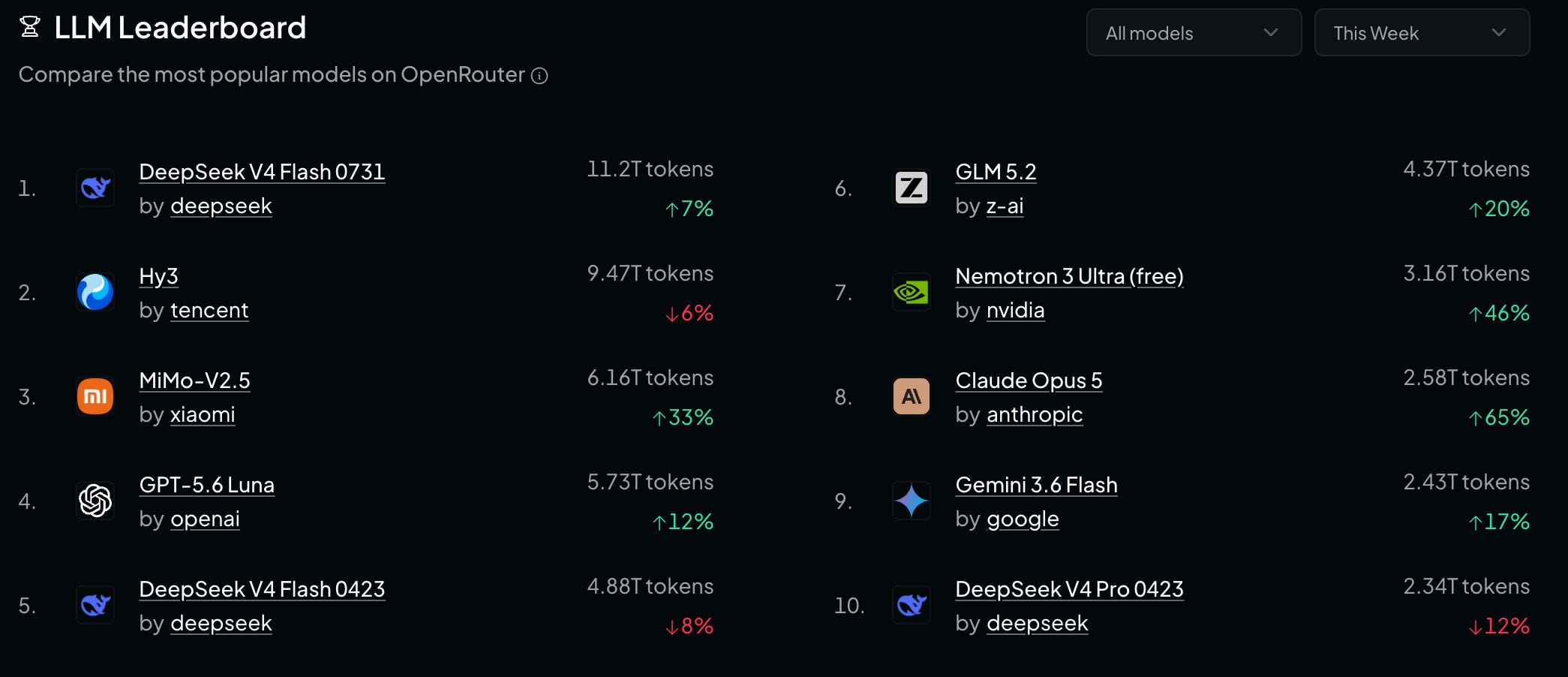
Less cynically, they provide companies with real-time cost metrics of their AI token spend and give them knobs to easily redirect that traffic. The danger, of course, is that the cost-savings are quantitative (immediately tangible) while the performance-degradation is qualitative (fuzzy, harder to measure).
The problem they solve
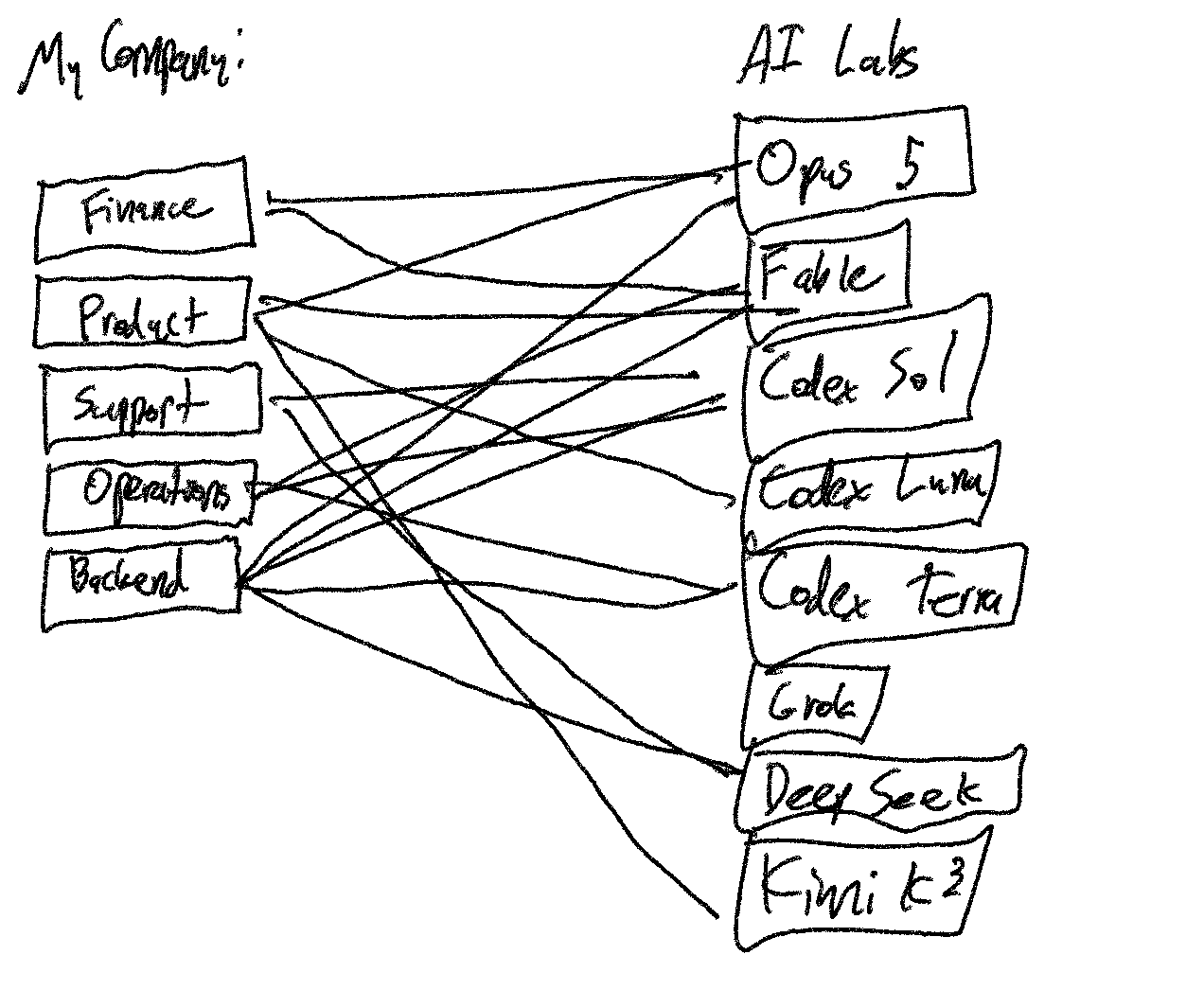
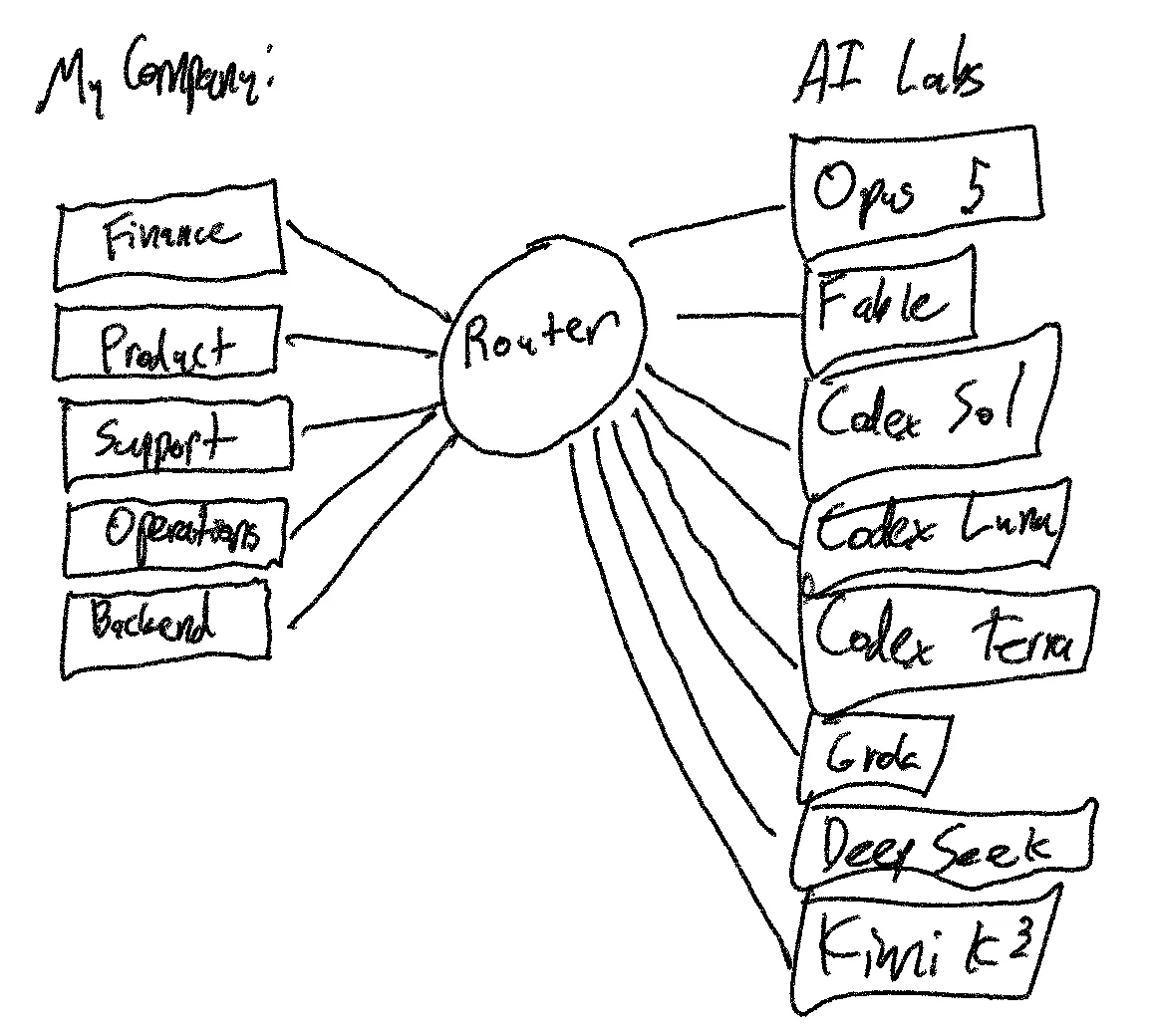
It’s a classic hub / integrator model. Multiple teams and people within each company are now using a mix of AI services, each with different cost / performance / compliance characteristics. Given that AI token spend is the fastest-growing expense category, every finance team under the sun wants to throw a router into this mess:
Why OpenRouter is worth billions of dollars
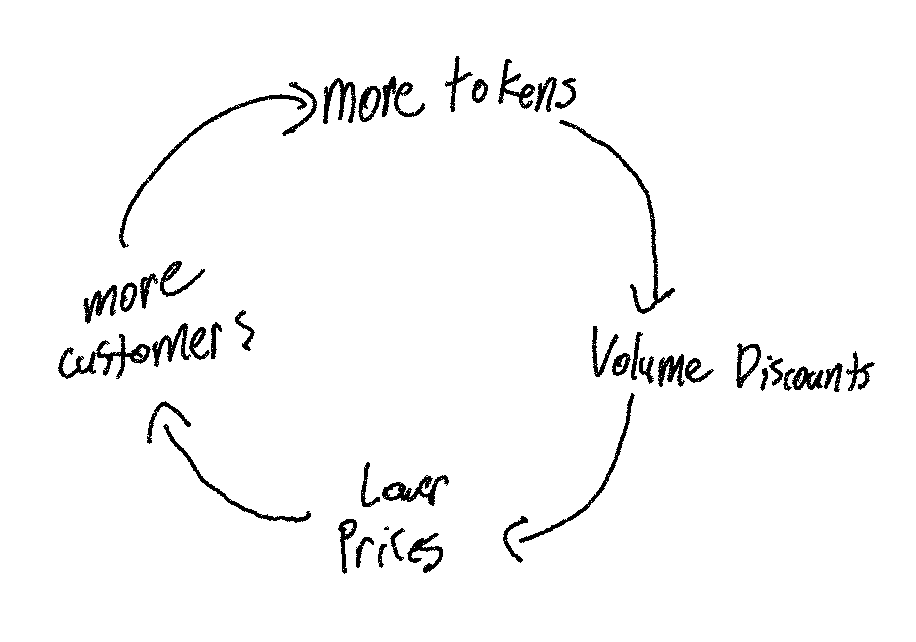
Obviously, OpenRouter has a lot of users and is growing exponentially, and that distribution is way more valuable than the software IP. More interestingly, OpenRouter has one of the greatest flywheels in the history of capitalism: volume discounts with the model providers.
These volume-discounts allow OpenRouter to offer lower prices, and given the cost-sensitive nature of the token-optimization market, this leads to more customers, more token traffic, and more volume discounts, and this basically guarantees that the largest routing company will always have the lowest prices. It also means that OpenRouter can charge a healthy margin on all AI token spend and still provide customers with the lowest inference prices. Given that the potential TAM of token spend is ~infinity… that’s a valuable company.
What Ramp is doing
Stripe and Ramp aren’t direct competitors yet, but as infinitely-ambitious fintech companies, they’re bound to battle on some fronts. Launching router.com is a reactive, defensive move for Ramp.
Ramp is, first and foremost, a set of tools for corporate finance teams. It makes perfect sense for them to launch their own point-solution for managing AI spend, but acquiring OpenRouter would be silly, because they can’t afford it they really wouldn’t know what to do with most of OpenRouter’s users. However, they’re probably worried about their customers using a Stripe product to manage their fastest-growing expense category.
Also, Ramp has supposedly been building this tool internally for 3 years, so it’s not like their investment was literally $0. The real price was the opportunity-cost of their product team’s focus, with the budget in dollars for “router.com” being essentially a rounding error compared to the OpenRouter acquisition.
But still, it’s hilarious and petty that Ramp shelled out for the shorter “router.com” days after Stripe’s “openrouter.com” announcement. We’ll see if the free-for-one-year price tag lets them get enough users → negotiate enough volume discounts with the model providers → provide inference at low enough prices → prevent their customers from using Stripe to manage token-spend… I’m skeptical they’ll win the whole market this way, but maybe they can get whatever critical-mass keeps them alive here.
What Else is Stripe Thinking
From Stripe’s side, this acquisition also complements a lot of their unique strategies:
Agentic Payments
Agentic payments represent less than 0.1% of e-commerce volume, but that could change fast given that more than 50% of web traffic is already non-human. Nobody is certain how this will play out, but there will likely be HUGE network effects for the most popular payment system for AI agents. With this acquisition, Stripe has the ability to tilt the odds in its favor by building first-class support for Stripe’s payment rails (Tempo or similar). They don’t even need to exclude other payment rails; just by grafting in a very slight advantage for themselves, Stripe can become the path-of-least-resistance to accept payments for all of OpenRouter’s users (human and otherwise). Given that OpenRouter’s users span all major model providers, this is a really smart play.
Orchestration
For years, Stripe has been trying to reposition itself as an orchestration company.
This is somewhat reactive to churn, as their business model (great bottoms-up developer experience, high price tag) means that their largest, most valuable customers eventually graduate off Stripe to competing platforms with lower rates (Adyen or similar). These customers end up with a lot of pain related to routing & reconciling payments across different processors. Stripe wants to become an orchestration layer for these partners, so that even if they lose (or partially lose) the processing relationship, they’ll still be an indispensable part of their payment stack.
This reposition is also forward-looking, in the sense that payment processing margins will likely trend to 0 over the long-term. In that world, Stripe needs to find other value-add services adjacent to payment processing to charge for.
It’s unclear how effective Stripe’s internal efforts to build orchestration have been. I’m not sure what adoption looks like for their largest partners, and the features are mostly useless to the overwhelming majority of customers who are single-processor. In other words, if you only use Stripe, you don’t really need payment orchestration.
Whether the issue was Stripe’s orchestration product or simply the problem-space it was built around, the acquisition of OpenRouter solves it. Everyone has (or will soon have) an AI orchestration problem, and OpenRouter has solved it better than anyone else (as evidenced by all the users).
Metered Billing
I’m not sure if this is good or bad; it might actually be an inefficient redundancy in the acquisition. Stripe’s usage-based billing product (Metronome, which they acquired only a few years ago) is apparently quite good and is seeing healthy traction, but this metered-billing is also a core feature of OpenRouter’s platform. There is obviously some sort of spiritual alignment between the teams, but redundancy in M&A is typically a negative thing. But, I dunno, maybe they’re more different than I realize, or maybe they’ll find a way to integrate the teams and trojan-horse some deeper orchestration features into their metered-billing customers.
Why This is Bad for Frontier Labs
tl;dr
This disintermediates Anthropic / OpenAI / etc… from the end-users and commoditizes the inference market.
Commoditization
Widespread adoption of this router pattern makes it easier for companies to switch model providers and harder for model providers to compete on anything besides token cost & quality. By forcing all inference through a single interface, the margin opportunity of proprietary integrations or differentiated context-management is categorically eliminated.
Switching Costs
When some team integrates an AI service (think Claude Fable) into their workflow, the switching cost can be tedious for the company. If leadership wants to migrate to cheaper models, they have to ask this team to perform the switch. This team then gets a chance to explain why the higher-quality inference is valuable for their special use-case, and there is ultimately a lot of hand-to-hand combat involved in the transition. However, if companies use a model router… leadership can just push a button in a dashboard.
Differentiated Integrations
There is a lot of nuance in the proprietary context-management tooling that gets lost when you shove all the models behind 1 blunt API. As one trivial example of this, many users love the terminal-based Claude Code product because it “wraps” Anthropic’s models more effectively than Cursor and other IDEs.
This moat around harnesses (and tooling generally) feels temporary; OpenRouter and Cursor and everyone else will eventually get better at intelligently managing context for different models. It’s also worth noting that a lot of the traffic OpenRouter absorbs was already happening behind blunt inference APIs anyways (think string-concatenation, like “Please reply correctly and politely to this customer who said: “ + customer_text), so in practice there’s usually not much quality-loss when using the exact same model via OpenRouter vs directly… but these tools categorically prevent the labs from deploying deeper integrations.
Obviously, this creates a more efficient marketplace for inference that the customers (and scrappy, cheap model providers) love, while the incumbent model providers would prefer all of their customers to build stickier direct integrations… but I think we’re past the point of no return. Given the token volume through these hubs, it seems impossible for any frontier lab to categorically stop cooperating with the routing services.
This is somewhat bleak for new model development because the frontier labs essentially finance the billions-of-dollars it takes to create next-gen models against the future inference revenue of that model. If more of the inference traffic shifts to the cheaper distilled models, the AI labs will need some other way to finance the training of large new models.
Conclusion (Why This is Good for Humanity)
On the surface, there is some irony that the frontier labs are promising “intelligence too cheap to meter” while the hottest category in fintech is simply managing the token spend. However, it’s exactly this kind of commoditization that creates more efficient free-market dynamics that will drive the price of tokens down faster. It also shifts the balance-of-power slightly away from the model providers and toward the consumers in the best way possible: using free-market incentives (and not via regulation).
Random Thoughts
Personal musings, feel free to skip, these go on forever:
I think it’s incredible how fast some of these decisions are happening; Stripe’s acquisition announcement was largely unexpected, and Ramp responded in days by commercializing their internal tool and launching it as router.com. The pace of software-product-development is picking up!
I feel like a new inflection-point in B2B SaaS is imminent, where the cost to build & maintain a tool internally drops below the cost of the procurement / RFP process of an enterprise sales cycle.
I also second-guessed myself every time I wrote an example using “teams” at companies, because I know a lot of individuals who are now effectively managing multiple functions, and continuing the trend further I’ve read stories of agents doing the same (although I haven’t personally seen it).
In their recent investor update, Stripe mentioned “deft helmsmanship” in the age of the singularity being a reason for delaying an IPO, which feels like the opposite of Elon Musk’s strategy, given that he batched Starlink / xAI / SpaceX and rushed to go public ahead of the singularity. Maybe he just has more ambitious cap-ex and needs some cash.
If I was an employee at a typical big tech company and the CEO started talking about “deft helmsmanship” I would assume lots of teams are about to get fired… but this is Stripe, and they really believe in the singularity, so maybe they just mean boldly re-inventing the company overnight (or shooting more $7B shots from the hip).
I personally like how the Collison brothers sprinkle these ten-dollar-words strategically into their writing and speeches (words like “recalcitrant” etc…).
In my opinion, the quantity-vs-quality problems with these router tools ultimately won’t matter. It’s not a new category of problem; anyone who has defended a large expense on creative work to company leadership knows this pain already (replacing in-house developers with cheap overseas ones, or negotiating salary with a principal designer or marketing leader). These tools are just levers that can more efficiently and quickly magnify the cultural impact of the real decision-makers within a company.
So, while the narrow token-marketplace might not price in some of the attributes like quality, the broader markets in which the token consumers themselves compete should measure something like quality in a global sense. Sure, there are lots of blog posts and best-practices for running A/B tests to tune prompts & model-providers, but these ultimately need some scoring function, and you lose something… anyways, I’m less interested in the category of products that quantify the quality of tokens… it’s obviously the right thing to do at scale, but good taste & judgement are just way more fun.
Of course, there are other externalities not priced into any markets (like proxying a lot of our AI traffic through foreign nations)… but most of the Chinese models are actually served via hosting-providers in the US. So, similar to my fears with TikTok, I’m not as worried about China getting our data as I am about China’s AI models having a formative impact on the daily decisions & worldview of the American people… but honestly, I don’t worry about this too much either.
Over time, the balance of power could shift too far away from the model companies to these routing companies. You could imagine a world where most of a model provider’s revenue comes via OpenRouter, and how OpenRouter might be incentivized to actively discourage any direct-to-consumer integration with the model providers, sort-of like an exclusive retailer / wholesaler relationship (or worse, like a TurboTax perverse incentive). This feels unlikely, but it’s fun to think about.
There are a lot of other ways this could shake out… I’ve seen arguments like this that Stripe and OpenRouter are essentially similar companies in that they provide a clean abstraction over multiple providers (the providers just happen to be processing money in 1 case and tokens in another case). To me, this sounds like someone worked on this particular thing at Stripe, so now they view everything through that lens. There is some merit to the idea that both companies are providing a single abstraction layer over multiple underlying providers, but that could apply to a lot of online businesses, not just Stripe & OpenRouter.
The analogy breaks down for me because the whole point of OpenRouter is that their customers can selectively route traffic to their preferred providers, which creates immense competition among the underlying providers. With payments, you have to honor whatever payment method the end-consumer shows up with, which creates a much different (and far less competitive) relationship with the underlying card networks and payment methods.
There is also the pseudo-religious angle, which is this vague idea that scarce compute will become the fundamental economic unit… but didn’t we already try that with Bitcoin? Let’s not revisit that one, please.